
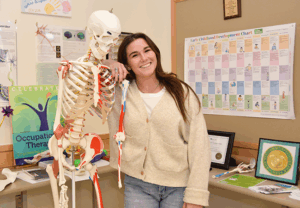
Julia Cope
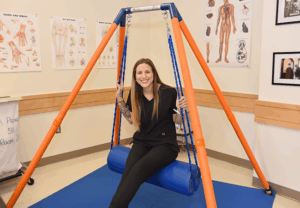
Courtnee McKenzie
Occupational therapy is a vital field that can help people in all walks of life. That’s what appealed to students Courtnee McKenzie of Salisbury and Julia Cope of Snow Hill. Both came to Wor-Wic’s competitive occupational therapy assistant (OTA) program after earning bachelor’s degrees in exercise science.
McKenzie said COVID-19 started her on the path to OTA after she graduated from Towson University in Baltimore. “COVID was a confusing time, and I wasn’t sure what to do next. After taking time off, I looked into health care programs near me that were affordable and possibly interesting. Google led me to Wor-Wic,” she said. “Occupational therapy was a profession that I had briefly heard of, but didn’t know much about. A mandatory interest meeting hooked me right in. Sometimes you don’t know what you’re passionate about until you really start looking for it.”
Cope had a similar experience. “After trying different types of jobs and seeing what I might want to do as a career, I came back to the health setting,” she said. “I found Wor-Wic and they offered both PTA and OTA programs. I signed up for the orientation for OTA to learn more about it. Immediately after the session, I felt like myself! I was actually excited. So, I applied for the OTA program and luckily got accepted.”
OTA offers what many people value about health care professions: a human connection. “Occupational therapy looks at all aspects of an individual to help create their treatment plan. They don’t just look at the mechanical/physical side of a person,” Cope said. “OT creates a client-centered treatment plan that is very specific to the person. I really appreciate that, because humans are a complex and complicated specimen. Physical, spiritual and mental health are all connected, and I really like that occupational therapy practices that.”
Wor-Wic’s OTA program prepares students to help patients develop, recover and improve the skills needed for daily living and working. Clinical experience can take them to a variety of local institutions, including hospitals, long-term care facilities, day care centers, pediatric centers and school systems.
McKenzie said she looks forward to a career that will allow her to help people. She’s hoping to specialize in pediatric OTA. For anyone interested in the program, she is encouraging.
“If you’re thinking about it, look into it,” she said. “Google what OT is, what OTAs do, and what difference you could make as an OTA. Attend the interest meeting, set up goals to complete your health administration requirements and apply! Attending and completing this program will be one of the most rewarding things ever. What’s even better is the difference you can make in your community, or wherever your skills take you.”