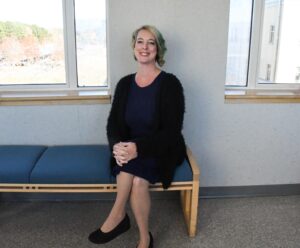
Dr. Jenny L. McFadden, an associate professor of transitional English at Wor-Wic Community College, says seven-week terms can help students achieve their goals better.
Wor-Wic Community College has been selected to participate in a new nationwide effort to help state and college higher education systems scale the adoption of shortened academic terms.
The Scaling Shortened Academic Terms initiative is led by Achieving the Dream (ATD), a national reform network committed to advancing community colleges as accessible hubs of learning, credentialing and economic mobility, and is funded by Ascendium Education Group. The project will support Wor-Wic and other participating colleges in accelerating their progress in shortened academic terms as a strategy to improve student outcomes and align academic structures with the complex needs of today’s learners.
Traditional 15-week semesters can pose barriers for students who balance college with work, family and other responsibilities. Wor-Wic introduced seven-week course options in 2024, and plans to use the initiative to build on the existing classes’ success. The seven-week options offer the same amount of credit as the traditional 15-week classes, and meet more often, usually in a hybrid format, to ensure students are meeting academic goals.
Dr. Jenny L. McFadden, an associate professor of transitional English, said it has been especially helpful in her classes.
“Many of our students have challenging lives,” McFadden said. “The shorter terms help them get through classes before the roulette wheel of life hits — whether it’s transportation issues, work or family. If we can teach them what they need in seven weeks, they are better positioned and more confident.”
McFadden says she has seen a jump in the number of students passing her class. “And they’re not just passing — they’re passing with higher grades,” she said. She attributes this to the momentum that the shorter terms help students sustain.
“There’s not as much time to forget material you learned in the first week, and again, there is less of a chance to let life get in the way,” she said. “I love to see the sense of accomplishment they have. These successes encourage them to keep going.”
Research and institutional experience show that well-designed short-term structures can boost course completion rates, increase persistence and strengthen student confidence. Scaling such models, however, requires intentional design, strong student supports and alignment with institutional goals.
“It was a challenge designing the classes at first,” McFadden said. “But when I took a professional development workshop on how to design the classes, it fell into place how I could make sure they were meeting all of their objectives.”
The Scaling Shortened Academic Terms initiative will help participating colleges like Wor-Wic build the capacity to design, implement and sustain more shortened term classes in ways that advance student success and expand the field’s evidence base for effective reform. Through targeted coaching, professional development, cross-state learning and data-informed decision-making, ATD will help participating colleges embed and sustain shortened term formats in ways that enhance student momentum and credential attainment.
“I have seen that even with challenges, the goal is worth it, and the pass rates are worth it,” McFadden said. “It is a more sustainable model that is growing student success.”
The Community College Research Center (CCRC) at Teachers College, Columbia University, will lead a comprehensive external evaluation of the initiative to deepen the evidence base on effective design and implementation of shortened academic terms.
“This initiative reflects the kind of whole-college transformation ATD supports across our Network,” said ATD President and CEO Dr. Karen A. Stout. “By working with states and institutions already leading this change, we can scale structures that help students — especially adults and working learners — build momentum and achieve their goals. Equally important, the evaluation led by the Community College Research Center will provide the evidence the field needs to understand which students benefit most, what conditions enable success and how to sustain these models over time. Together with our partners and Ascendium’s support, we are expanding both the evidence and the capacity needed to make shortened terms a sustainable part of student success strategies nationwide.”
“We are pleased to have the support of ATD in scaling up this important ‘rocket booster’ for student success that will help our students learn with confidence, carry full-time course loads that they might not have thought possible and reach the graduation stage faster than they expected,” said Deborah Casey, Ph.D., president of Wor-Wic. “Our faculty has done an outstanding job in starting the seven-week classes, and we are happy to have additional supports to help continue this initiative.”